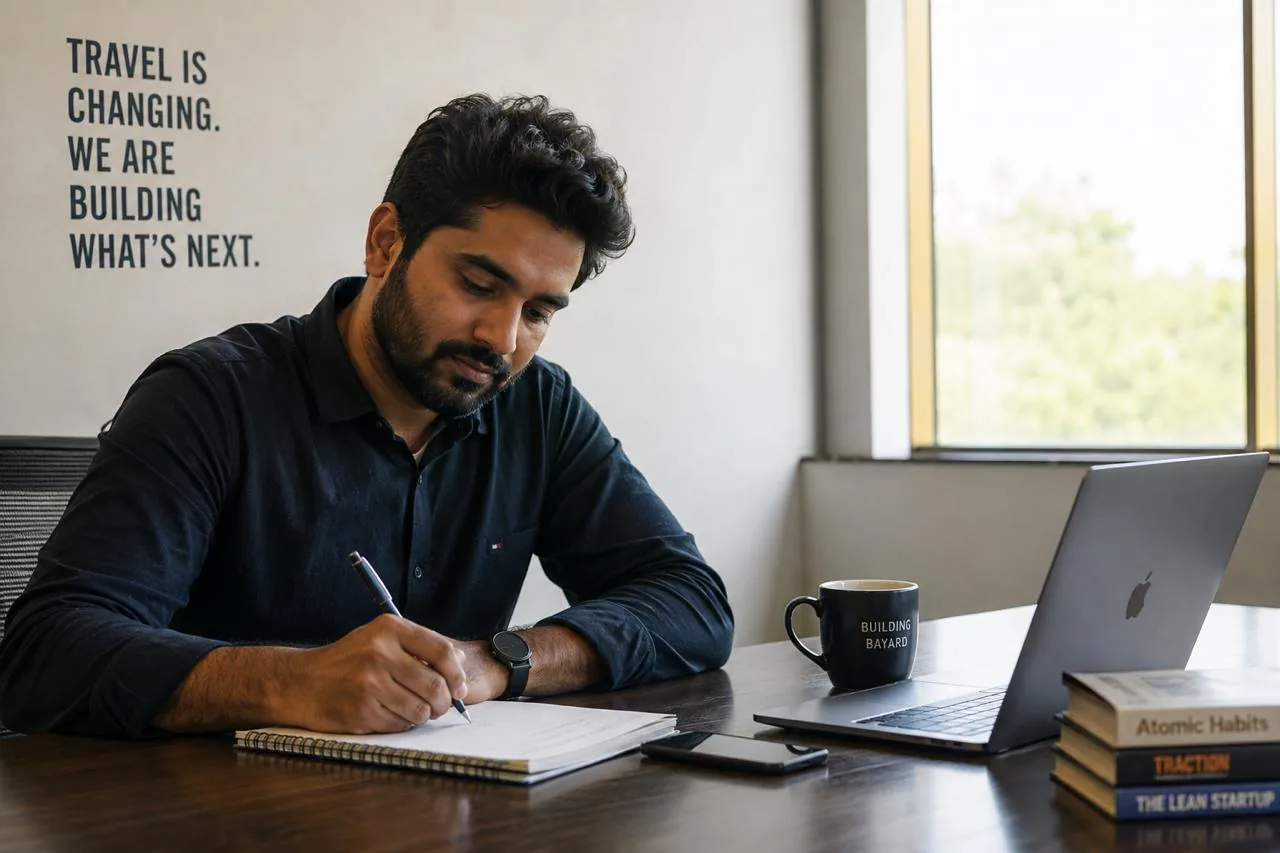
I did not begin this journey as a technology founder. I began it as a tourism professional who believed that exceptional travel came from relationships, operational discipline, and understanding what a traveller truly needs.
The pandemic forced me to rethink not only our business model, but also my own role as a founder.
There is a version of this journey that looks clean on LinkedIn: an educational-tour operator pivoted to FIT during the pandemic, built a CRM, and scaled up. The real story had far more 2 AM arguments, wasted money, uncomfortable lessons, and moments when I genuinely wondered whether I understood my own business anymore.
-This is that story.
Where I Started
I learned tourism from the ground up: itineraries, vendor relationships, group logistics, and the human side of travel. Technology was never “my thing.” It felt like a separate world - one built for corporate giants, not for a traditional tour operator whose strength was human touch.
Whenever I heard, “It’s a tech problem,” I mentally filed it under someone else’s job.
Then the pandemic happened.
Educational tours — our entire business model at the time disappeared overnight. I had to pivot into FIT (Free Independent Traveler) travel, a segment I had not operated in before. It was not a strategic choice made from comfort. It was survival.
Building Trust From Zero, Again
Slowly, we found our footing. We built a client base, earned trust, and started to matter in the industry again. But being a small, traditional tour operator came with a difficult reality: without a meaningful digital presence, we would never become relevant beyond our local market.
That pushed me into SEO, digital marketing, websites, and online visibility - at least at a surface level initially, because I was still running the business at the same time.
I outsourced a basic website and some digital marketing. It gave us a presence, but presence was never my goal.
I wanted people to know Bayard Vacations - not simply find us online.
The CRM Decision That Changed Everything
The turning point came when I met Sharan, who happened to be in the same building. He brought technical strength; I brought industry depth. Together, we discussed a custom CRM and dynamic website that could support the scale I envisioned for Bayard Vacations.
The package was far beyond my budget at the time. But his confidence, combined with my vision for the future, convinced me to take that leap.
What followed was one of the most intense periods of my professional life. Every night, our discussions would begin around 10 PM and often run until 5 AM, 6 AM, or sometimes even 7 AM.
I had the business and travel-industry context, but I lacked the technical vocabulary. Sharan understood the technology, but did not yet know the nuances of travel operations. We spent long nights bridging that gap.
Strangely, fatigue never won. Every technical hurdle became an operational opportunity. But wanting to solve a problem and being able to execute the solution are two very different things.
Version 1: Impressive, Then Humbling
We launched a Version 1 that genuinely impressed us. For a moment, it felt like we had built something substantial.
Then we started benchmarking it against the market and against what established travel companies were already capable of. The gap was bigger than we wanted to admit.
People who understood the depth of the problem quietly saw that our early prototype was, in some ways, a burden dressed up as a product. It was a necessary stepping stone, but it was not where we needed to be.
That silence was its own kind of pressure. Nobody outside the two of us not even friends or family fully understood what we were building or what it was costing us in time, money, and energy.
The Rebuild
Eventually, we had to confront the truth: a year of effort, time, and money had produced something that was not truly useful enough. So we rebuilt — again.
And the same constraints resurfaced immediately: team, time, and money. Always the same three walls.
That was when I made a decision that changed our structure for good: we would bring technology in-house instead of relying on an outsourced build that we did not fully own or understand.
We began as a 7–9 person team handling everything. Then we made our first in-house technology hires: one backend developer and one frontend developer.
We also chose to build silently. Some core infrastructure tools are live and helping our clients today; others are still being perfected behind the scenes. But every piece is now being built around actual utility.
The Real Lesson: Tech Without Industry Context Is Just Code
Working with our in-house hires taught me a lesson that reshaped how I think about product-building.
They had technical ability, but business logic and industry context had to be infused into every workflow, feature, and decision. That knowledge transfer took time. And in that gap, hard questions emerged: Was the earlier build relevant? Was it solving the right problem? Were we building features, or were we building solutions?
We brought Sharan back to fix and rebuild key parts. For some time, things felt smoother. Then we reached the deeper realization:
“Building tech is not the goal. Solving the client’s actual problem, clarity, convenience, and speed is.”
That realization changed everything.
We hired more people, including additional backend support. At one point, our technology and marketing headcount was nearly equal to our sales and operations team. That imbalance was a signal too. It forced us to invest again in sales and operations training the team to become future-ready alongside the platform.
Where We Stand Today
Today, Bayard Vacations has grown to nearly 35 in-house team members.
Seven people are dedicated purely to technology, while four are focused on marketing. This 11-person core is driving a significant part of our platform evolution, while our sales, operations, and client-servicing teams continue to bring the human expertise that travel will always require.
Right now, our client-facing AI interface is still, honestly, a basic chatbot. But that changes on the month September - October.
From that day, it is designed to become a genuine problem-solver — capable of supporting clients with more depth than scripted responses. We are also preparing several other technology-supported features, but I would rather let the work speak for itself when the time comes than reveal everything too early.
This story is not finished. It is very much a “to be continued.” I intend to keep documenting it, page by page, as we approach September - October and move beyond it.
What I Would Tell Traditional Business Owners
Looking back, the hardest part was never technology itself.
It was accepting that I did not need to become a technologist to build a tech-enabled company. I needed to become fluent enough to ask better questions, challenge the right assumptions, hire people whose strengths complemented my own, and stay honest about whether we were solving real problems or simply building impressive-looking versions of them.
As the founder of Bayard Vacations, I am still learning, rebuilding, and growing with the team. We are still building often silently and rolling out features only when they genuinely solve a problem.
But every wasted rebuild, every 5 AM meeting, and every uncomfortable truth about Version 1 versus what the market actually needed taught me something that no course on technology, business, or fundraising could have taught me.
At Bayard Vacations, we are not just selling trips anymore. We are engineering a more intelligent, transparent, and traveller-first future.
And I am documenting that journey one honest chapter at a time.
By Chethan Kumar N P, Founder & CEO, Bayard Vacations
Start Your Adventure
Our travel experts are ready to plan your next dream vacation.
No spam, only pure inspiration.